Our paper Uni-X, which explores architectures for unified multimodal models (UMMs) that support both generation and understanding, was accepted to ICLR 2026. Within a simple autoregressive (AR) framework, we aim to resolve the conflict between text and vision. In brief, we introduce separate branches for the two modalities in the shallow and deep layers of the model.
A common approach to building AR UMMs is to convert visual inputs into discrete tokens through vector quantization, then model text and vision as a single sequence. Our experiments show, however, that a standard Transformer with fully shared parameters encounters severe gradient conflict when processing these multimodal inputs.
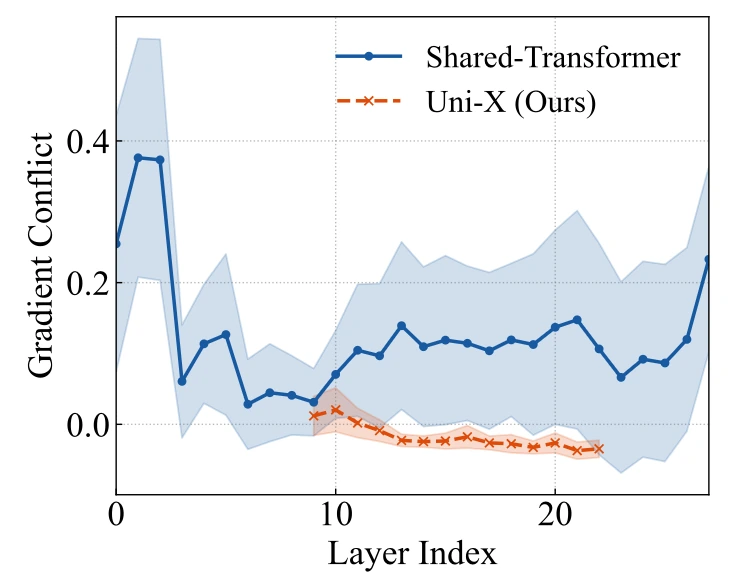
Gradient conflict in the FFN down-projection weights of a standard Transformer. Conflict is particularly severe in the shallow and deep layers and weaker in the middle layers. The Uni-X architecture reduces it further.
To characterize this phenomenon, we define a layer-wise gradient conflict metric, . We compute the cosine similarity between gradients from text-only data, , and image–text pairs, , then subtract the baseline gradient similarity under the mixed-modality data distribution, , giving:
Where conflict comes from: entropy differences in low-level representations
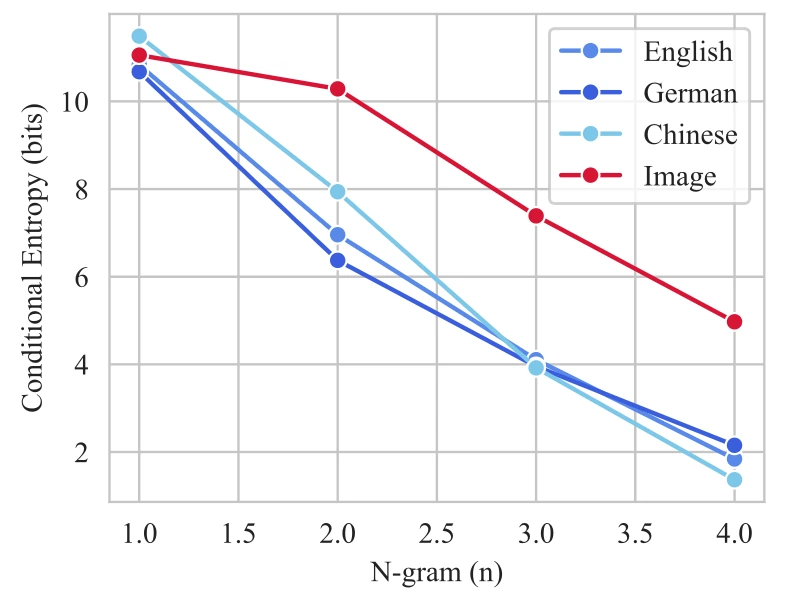
Why does this happen? We explore an explanation from information theory: visual sequences produced by vector quantization differ substantially from natural language. Our N-gram conditional entropy analysis shows that visual token sequences have significantly higher conditional entropy than English, German, or Chinese text. This high entropy makes visual sequences harder to predict, requiring the model to capture longer-range and more spatially entangled dependencies.
Visual token sequences have substantially higher conditional entropy than natural languages such as English, German, and Chinese.
When a single network must process both low-entropy, grammatically structured text and high-entropy, spatially structured visual inputs, its shallow layers, which extract low-level features, and its deep layers, which predict the target distribution, must reconcile very different statistics. This produces strong conflict between their gradients. In the middle layers, representations become more abstract and semantic, making cross-modal alignment more natural and reducing conflict.
2. Uni-X: two-end-separated, middle-shared
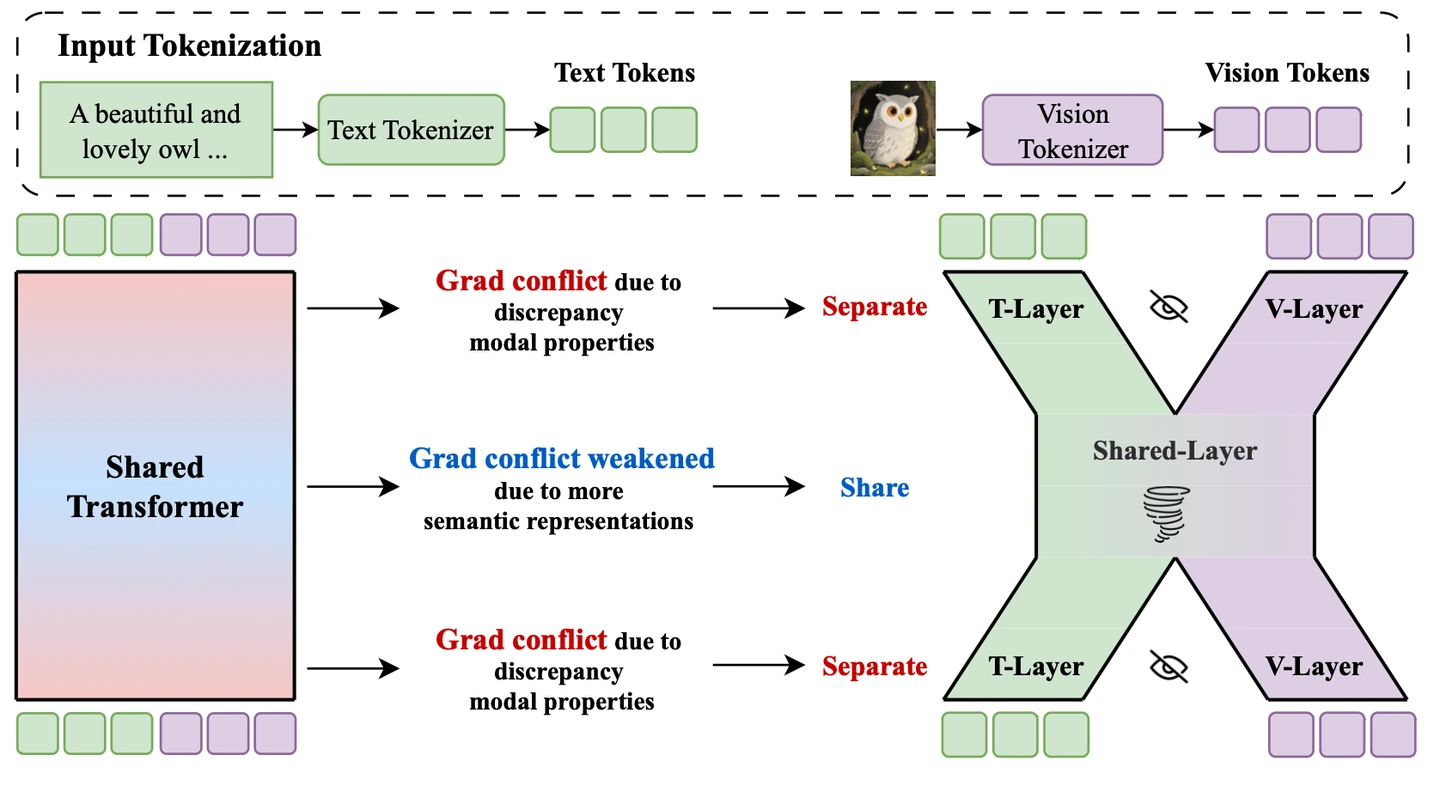
Instead of relying solely on external visual semantic encoders or complex task-specific branches, we align the architecture with the inherent properties of the modalities. We propose Uni-X, an X-shaped architecture with separate ends and a shared middle:
Uni-X compared with a standard shared Transformer. Separating the two ends avoids severe gradient conflict, while the shared core supports feature alignment.
Separated layers: the first and last Transformer layers are split into parallel, modality-specific branches. Text and visual tokens are processed independently during early feature extraction and final token projection, isolating the optimization conflicts caused by their different low-level distributions.
Shared layers: the middle layers retain shared parameters and focus on cross-modal fusion and reasoning over high-level semantic features.
Connections to encoder–decoder architectures
Our design is also partly inspired by the classic encoder–decoder architecture. We hope the separated layers can serve as an encoder and decoder, respectively, although time and resource constraints prevented us from conducting dedicated analyses. One interesting question is whether the shallow separated branches could be used directly as a dual-encoder model with reasonable retrieval performance.
An additional benefit in theoretical compute efficiency
Beyond the optimization benefits, visual and textual tokens follow separate computation paths in the separated layers. For a sequence of length , containing visual tokens and text tokens, self-attention complexity drops from the fully shared to a quantity proportional to . This gives Uni-X a higher theoretical ceiling for training and inference throughput at the same parameter scale.
3. Experimental results
Under matched training budgets, the 3B-parameter version of Uni-X demonstrates strong scaling behavior and competitive performance:
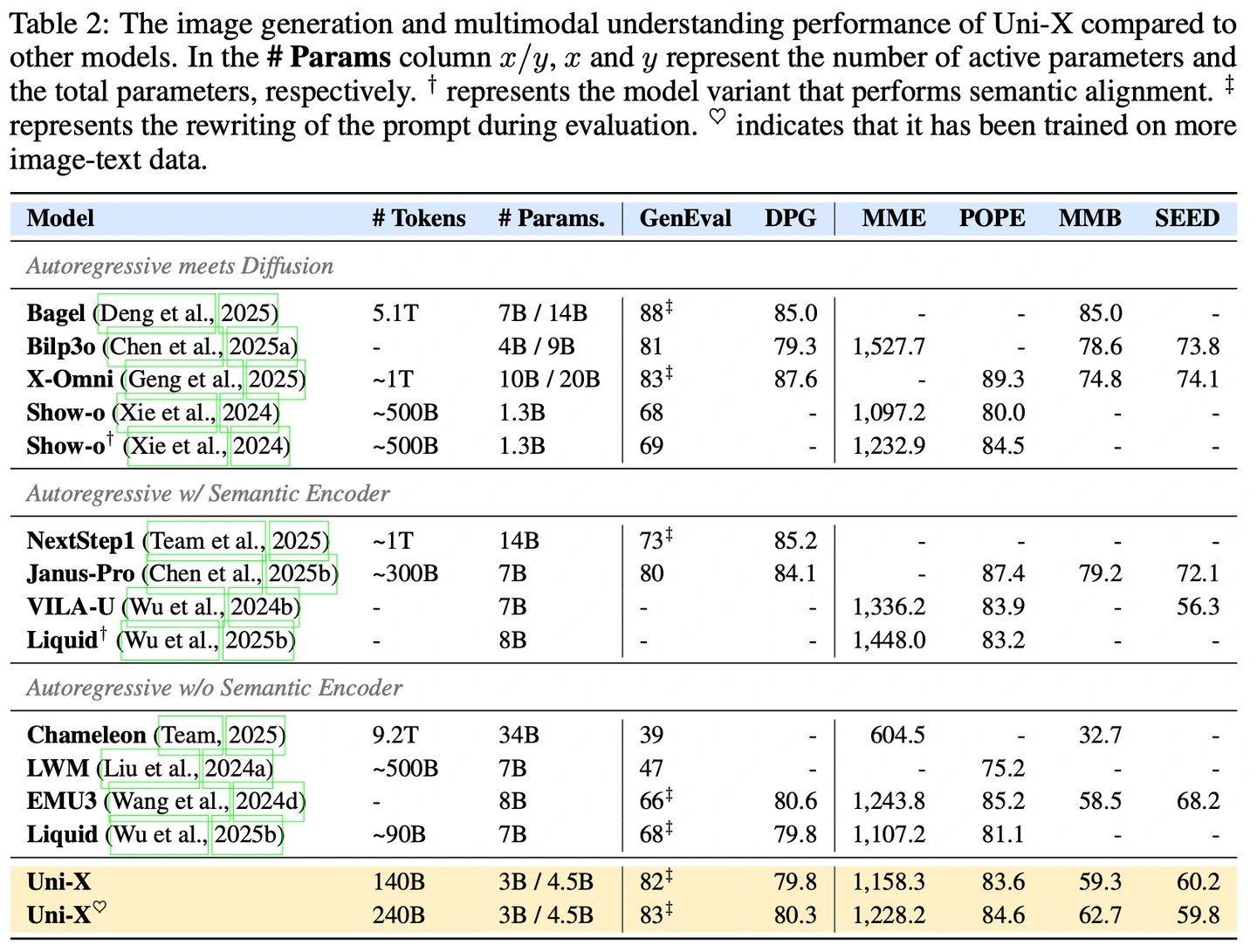
Image generation and understanding: without an additional semantic encoder, the model achieves a score of 82 on GenEval, matching or exceeding some 7B autoregressive UMMs.
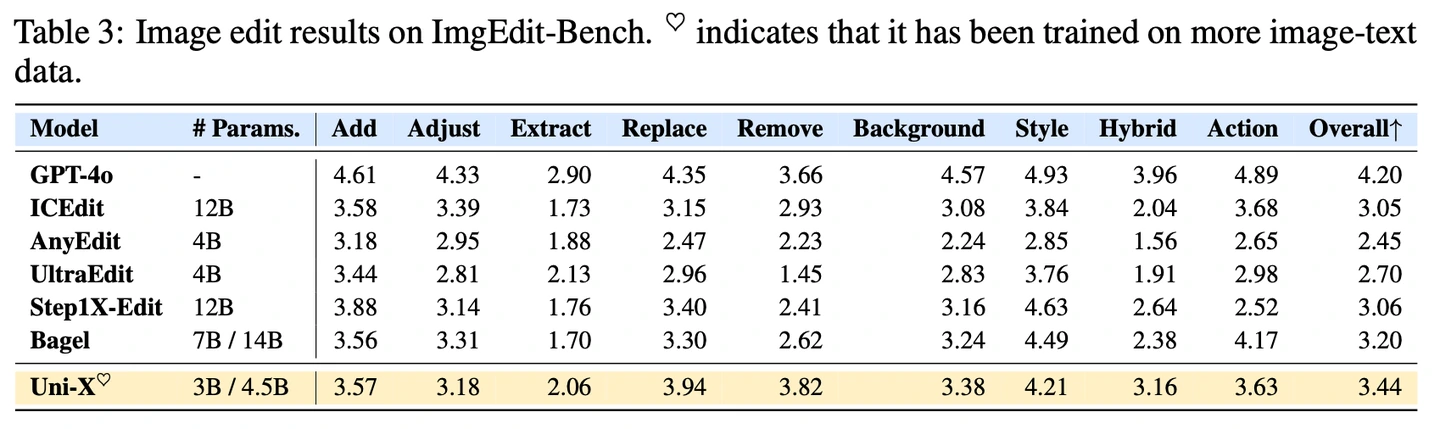
Image editing and zero-shot generalization: after fine-tuning on only about 90K image-editing examples, Uni-X achieves overall ImgEdit leaderboard performance comparable to Bagel, which uses more data and a larger model. The shared middle layers provide the semantic alignment that supports this capability.
Future work
Not relying on an external visual feature extractor such as CLIP does limit Uni-X’s multimodal understanding performance to some extent. We plan to explore whether VQ-VAE, the intermediate tokenization component, can also be removed. If the branches of the “X” directly perform tokenization and detokenization, we may be able to achieve truly end-to-end, pixel-to-pixel unified multimodal modeling.